Thomas Arthur Leith (Pop)
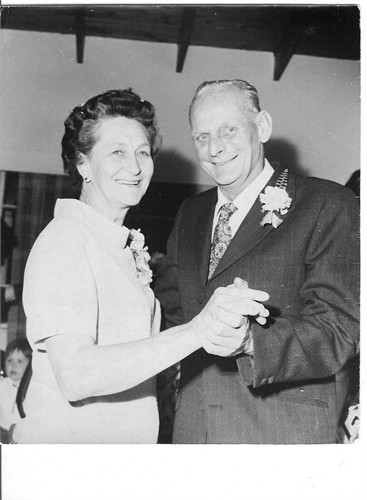
Pop volunteered for the Union Defence Force on 21st June 1940 at the age of 24. His records show he seems to have suffered ill health and was admitted to hospital during August and September 1940 and then has an unexplained 6 month period of release from the army. His records show several changes in regiment before finally arriving in Suez aboard the SS Llandaff Castle on 18th December 1941.
Rommel’s offensive to take Tobruk in May / June of 1942 is often referred to as one of his great victories. For the South African military, the first battle in November 1941 is known as one of their worst defeats. Pop was part of reinforcements that arrived in Egypt to replace those lost in the battles around Tobruk in November 1941.
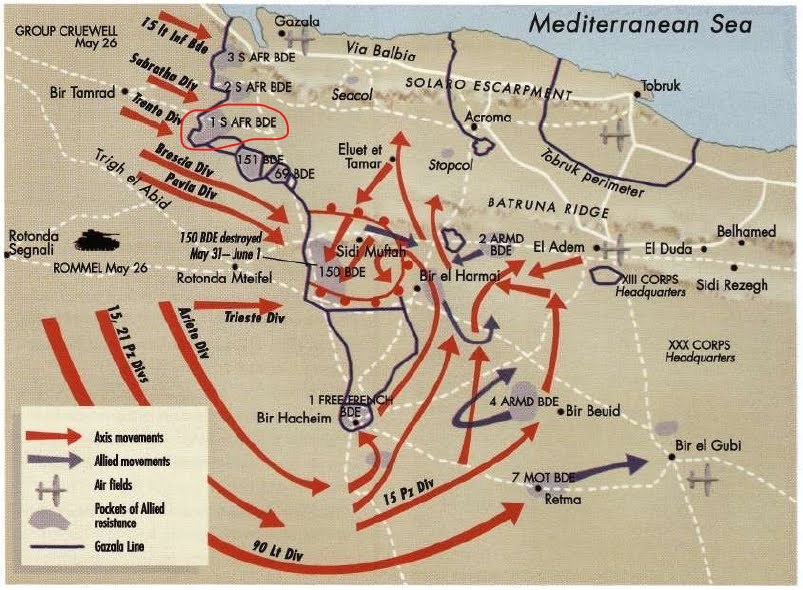
Pop was stationed at the northern edge of the Gazala line in spring 1942 (see picture above). Much of the initial action during May happened to the south of these positions as Rommel used his famous flanking manoeuvres to try and encircle key defensive boxes and avoid a costly frontal assault. This work was done mainly by the 15th and 21st Panzer Divisions while Italian infantry with some armoured support made attacks on the northern / central defensive positions to keep the troops there engaged and give the impression that this was where the main push would come.
The 15th and 21st Panzer Divisions engaged in some furious battles to complete their flanking manoeuvre, most notably, The Cauldron and the subsequent break out to the north which left the Knightsbridge box surrounded and various British armour regiments seriously depleted. As Rommel gained momentum he ordered the 15th Panzer Division to push north to try and reach the Via Balbia coastal road and cut off the troops in the northern positions so they couldn’t retreat to Tobruk itself.
I know from a German officer’s war diary and other research I found online, that Pop was part of the rear guard for the SA 1st Division as it desperately tried to avoid being cut off in the retreat to Tobruk and then on to El Alamein. Various accounts tell of the order being given on the 14th June to abandon the northern Gazala positions (the Gazala Gallop) and retreat. Pop was captured on 16th June, which coincides with an account in a regimental diary that states:
This left the 50th British and 1st South Africa Divisions stuck in boxes to the north of Knightsbridge, cut off by the Axis, who were swarming towards Tobruk. These divisions were ordered to break out east while the 15th and 21st Panzer tried to cut them off. Weary units of 7th Armoured managed to delay the German armour allowing most of the 50th Division to escape and the 1st South Africa Division, withdrawing along the coast road lost only its rearguard. By now most of the 8th Army was in retreat to the El Alamein line.
After capture he was listed as a POW in Italian hands. Pop made his way through various camps and hospitals in Italy. The records I got from the International Red Cross mention transit camps from June ’42 to Nov ’42, then a hospital in Taranto for 3 months (Dec ’42 – Mar ’43), Camp PG 65 at Bari and Camp PG 52 at Chiavari. Eventually he arrived in Stalag VIIIB, Lamsdorf (modern day Łambinowice, Poland) on 28th Sept 1943.
While in Stalag VIIIB Pop was assigned to a number of work camps which were satellites to the main camp. The questionnaire he completed once he was repatriated via England in May 1945 refers to the following Arbeitskommado or work camps:
Oct 1943 to Dec 1943 a sugar factory at an unspecified location but which was in the upper Silesia region where the main camp was located.
Dec 1943 to May 1944 building and excavation in Dabrowa, an mining and industrial area east of Katowice, the main city in the region.
June 1944 to January 1945 working in a coal mine in Niwka, one of Poland’s oldest mining areas, also near Katowice. The conditions in these mines were very dangerous and POWs were generally used as labourers to support the Polish miners. This means they did the worst and most physically demanding jobs.
As with many other Allied POWs, he took part in the Long Marches which were during the winter of 1944-45 when POWs were marched out of their camps and into Germany to prevent liberation by allied forces. He started marching from Lamsdorf in southern Poland on 22nd January 1945. There were two marches from the camp. One went through southern Poland and into eastern Germany via Gorlitz and Dresden ending up south of Berlin. The other march took a route through northern Czechoslovakia into Bavaria to a camp near Nuremburg. I’m unsure exactly which route he took, but from the work caps he was in, it seems the route through Czechoslovakia seems the most likely. These marches were in sub-zero temperatures and heavy snow, often sleeping in the open and with little to no food. As a child my grandmother would always tell me to eat what was on my plate and be glad of it because during the war Pop had to eat potato peelings out of bins to survive. Another family story says he was left for dead on this march and thrown on a pile of other POW bodies, but was found by a priest who noticed that he was still alive and rescued him. I haven’t been able to corroborate this part of his story.
I knew my Pop briefly as a child, he passed away in hospital in Durban, South Africa when I was 6 years old. My memories are hazy but I’m glad I have them, especially the ones of visiting him in hospital. My parents say he rarely talked of the war, but on occasion, over a beer with my dad (who was in the South African army at the time) he did let some things slip. He talked with respect of the devastating accuracy of German artillery and tank gunners; and also the cruelty and barbarism of their counterparts serving as prison camp guards.
Uncovering Pop’s story has been a sobering experience. Never again will I feel sorry for myself when life gets difficult. What I face day to day will never come close to being left behind to slow enemy tanks while my friends retreat to fight another day. I am awed when I think about the consequences of a tank shell, a bullet, an artillery fragment, hypothermia and exhaustion. Any of these could have claimed his life, and if it had, I would not be here to write this.
Thanks for taking the time to read this. If I can help in any way to assist you in your own research, or if you think you may have further information that would help me, then please get in touch using the info on the front page.
Pop’s War Timeline
| Date | Place |
|---|---|
| 21/06/1940 | Enlisted – Durban |
| 29/08/1940 | Admitted to hospital with stomach problem ‘Enteric’ |
| 04/09/1940 | Discharged from hospital |
| 07/12/1940 | Admitted to hospital with Tick Bite Fever |
| 09/12/1940 | Discharged from hospital |
| 05/03/1941 | Excused for 6 months reason unknown |
| 02/10/1941 | Temporary Release |
| 14/10/1941 | Transferred to Prince Alfred’s Guards |
| 14/10/1941 | Returned to army Prince Alfred’s Guards |
| 11/11/1941 | Transferred to 2nd NMR |
| 30/11/1941 | Embarked Durban on SS Llandaff Castle troop ship |
| 18/12/1941 | Arrived in Suez |
| 07/01/1942 | Transferred to 1st SA Irish |
| 09/05/1942 | Transferred to 1st SA Anti-Tank Reg |
| 16/06/1942 | Captured at Gazala, Tobruk |
| 22/12/1942 | Admitted to POW Hospital in Brindisi, Italy |
| 30/12/1942 | Moved to hospital in Taranto, Italy |
| 28/02/1943 | Moved to hospital in Altimuro, Italy |
| 06/06/1943 | Moved to POW Camp CC 65 Gravina, Italy |
| 12/07/1943 | Transferred to POW Camp CC 52 PM 3100 Chiavari, Italy |
| 28/09/1943 | Transferred to Stalag VIIIB Lamsdorf now called Lambinowice, Poland |
| 10/10/1943 | Working in a Sugar Factory, place not specified. |
| 25/12/1943 | Working in building and excavation at work camp in Dombrova. Could be E513, E543 or E739 |
| 20/06/1944 | Working in a coal mine in Niwka, Work party E579 |
| 18/01/1945 | Long March into Germany via southern Poland |
| 14/05/1945 | POW arrived in UK |
| 19/07/1945 | Evacuated back to SA |
| 03/08/1945 | Arrived Capetown |
| 05/10/1945 | Arrived Pietermaritzburg |
| 08/10/1945 | Arrived Snell Parade, Durban |
| 14/11/1945 | Discharged from army |
 Cripps Family History
Interesting reading jase.
LikeLike
Jason, thanks for this fascinating bio of your grandfathers including my first cousin Thomas Arthur Leith which I’ll treasure.
Best regards, Ian.
LikeLike
Thanks Ian, glad you enjoyed it.
LikeLike